Wedding entourage list: every role in a Filipino wedding, with a sample
The Filipino wedding entourage list role by role: sponsors, secondary sponsors, attendants and bearers, with a copy-ready sample and what the law requires.
A Filipino wedding entourage is everyone with a named role in the ceremony: both sets of parents, the principal sponsors (ninong and ninang), the candle, veil and cord sponsors, the maid of honor and best man, bridesmaids and groomsmen, and the bearers and flower girls. The law requires only two witnesses of legal age. Everything else is custom.
Building yours on an invitation website? Open a sample invitation to see the page your entourage section will sit on.
What is legally required, and what is tradition?
Only the witnesses are required. The Family Code (Articles 3 and 6) says the couple must declare their consent "in the presence of not less than two witnesses of legal age", and those witnesses sign the marriage certificate. Legal age is 18 under Republic Act 6809.
In a Filipino wedding, the principal sponsors usually sign as those witnesses. The US bishops' outline of the Catholic rite notes that elsewhere the witnesses are "usually the best man and maid of honor". Either works. The parish decides who signs its own record.
| Part of the entourage | Required? | Where the rule comes from |
|---|---|---|
| Two witnesses of legal age | Yes, every wedding | Family Code Arts. 3 and 6 |
| Principal sponsors beyond two | No | Custom; the parish sets caps |
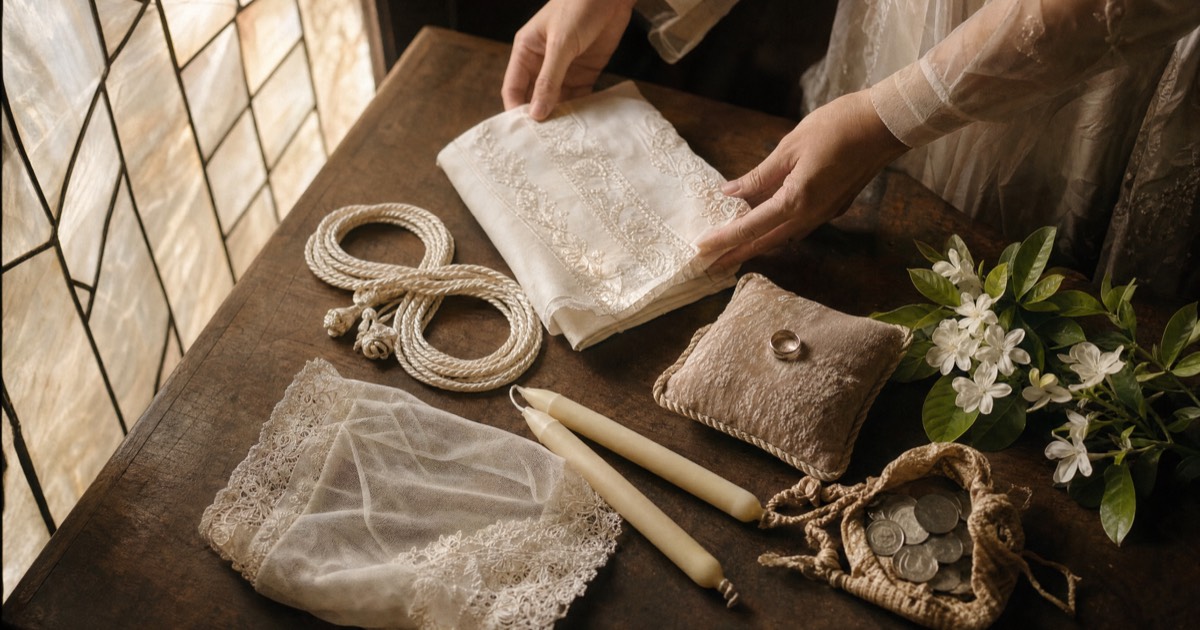
| Candle, veil and cord sponsors | No | Catholic custom |
| Arras (coins) and veil/cord rites | Optional parts of the rite | The Catholic rite itself |
| Attendants, bearers and flower girls | No | Custom |
The wedding entourage list, role by role
This is the full list for a Catholic church wedding. Civil weddings usually keep only part of it.
| Role | How many | Who usually fills it | What they do |
|---|---|---|---|
| Parents of the bride and groom | Both sets | Parents, or whoever raised you | Walk in the processional, sit in the first pew |
| Principal sponsors | Two or more, in pairs | Married elders you look up to | Witness and sign the certificate, stay on as wedding godparents |
| Best man, maid or matron of honor | One each | Your closest friend or sibling | Keep the rings, help the couple all day |
| Candle sponsors | One pair | Close friends, cousins or a bridesmaid and groomsman | Light the two candles beside the couple |
| Veil sponsors | One pair | Same | Drape the veil over the bride's head and the groom's shoulder |
| Cord sponsors | One pair | Same | Place the figure-eight cord (yugal) over the couple |
| Bridesmaids and groomsmen | Equal numbers | Friends and siblings | Walk in pairs, help with guests |
| Ring bearer | One | A young boy or girl in the family | Carries the rings (often dummy rings) on a pillow |
| Coin bearer | One | Same | Carries the arras (arrhae), the 13 coins |
| Bible bearer | One | Same | Carries the Bible |
| Flower girls | One or more | Young girls in the family | Walk ahead of the bride |
The children's ages vary by source. Nuptials.ph puts bearers and flower girls at three to nine years old, and The Budgetarian Bride says some churches want flower girls and bearers to be at least five. Ask your parish. Our wedding bearers guide covers what each bearer carries, boy or girl, and how to get a small child down the aisle.
Two newer roles show up on modern lists. A man of honor or best woman fits when your closest friend is not your gender, and Event Nest lists readers and offertory bearers as entourage roles too.
Sample wedding entourage list (copy-ready)
This is the layout most Filipino invitations use for the entourage page. Replace the brackets, delete the roles you don't have, and check every spelling with the family.
Parents of the Groom
Mr. and Mrs. [Full name]Parents of the Bride
Mr. and Mrs. [Full name]Principal Sponsors
Mr. [Full name] · Mrs. [Full name]
Mr. [Full name] · Mrs. [Full name]Best Man [Full name] · Maid of Honor [Full name]
Secondary Sponsors
To light our path: [Full name] and [Full name]
To clothe us as one: [Full name] and [Full name]
To bind us together: [Full name] and [Full name]Groomsmen [Full name], [Full name], [Full name]
Bridesmaids [Full name], [Full name], [Full name]Ring Bearer [Name] · Coin Bearer [Name] · Bible Bearer [Name]
Flower Girls [Name], [Name]
The "to light our path" lines are a common way to name the candle, veil and cord pairs. Plain labels ("Candle Sponsors") are just as correct. Principal sponsors go in pairs, one ninong beside one ninang on each line.
For how the entourage page fits with the rest of the card, see our wedding invitation format guide. The same list, lightly edited, goes into the wedding program you hand out at church.
How many principal sponsors can you have?
As many as your parish allows. The law sets only the minimum of two witnesses, and no national rule caps the rest. The Manila Cathedral, for example, allows "a maximum number of eight pairs of Sponsors" and gives the time for the ceremony and photos as the reason.
You'll find confident numbers online, and they don't agree. The Budgetarian Bride says a church wedding needs a "minimum of 2 pairs". Nuptl says most couples choose between 2 and 12 pairs. Other parishes set their own limits, and few publish them, so we won't give you a "normal" number either.
What decides it in practice:
- The parish rule. Ask the office how many sponsors may sign, and how many may stand at the altar. Those can be different numbers.
- The processional. Every pair adds time to the walk. Elderly sponsors can be seated before it starts and still be named on the list.
- The relationship. Principal sponsors become your wedding godparents. Our principal sponsors guide covers how to choose and how to ask.
Who are the secondary sponsors?
The secondary sponsors are the three pairs who perform the candle, veil and cord rites. The duties are in the table above; what varies is when each rite happens.
In the rite itself, the arras come right after the rings. The veil or cord (the "lazo") comes later, near the Nuptial Blessing, though the US bishops' outline allows it earlier "according to local custom". That outline names these traditions as "important in Hispanic and Filipino families". It has no candle step, which is one reason parishes place the candles differently.
The secondary sponsors are often your bridesmaids and groomsmen. The Budgetarian Bride puts it plainly: "For the Catholic church wedding, you will only need 3 bridesmaids: Candle, Veil, and Cord." If you'd rather honor more people, give the three rites to cousins or friends instead and keep the wedding party separate. The secondary sponsors guide goes through each pair's job, attire and how to ask them.
Church vs civil wedding entourage
A civil entourage can be as small as the two witnesses.
| Role | Catholic church wedding | Civil wedding |
|---|---|---|
| Witnesses | Two of legal age, usually principal sponsors | Two of legal age |
| More principal sponsors | Common; parish sets the limit | Optional |
| Candle, veil and cord sponsors | Common | Rare; the rites are Catholic in origin |
| Attendants and bearers | Common | Optional, often dropped in a judge's chambers |
Garden and beach civil weddings often borrow the church list anyway. The paperwork side is in our guides to church wedding requirements and civil wedding requirements.
Is the entourage list the same as the processional order?
Not quite. The printed list follows rank: parents, then sponsors, then the wedding party. The processional follows the aisle, and parishes arrange it differently. Some have the groom walk in with his parents first, others seat him at the altar.
Our processional order guide walks through the usual sequence position by position. Confirm the final order with your church coordinator at your first meeting, then print it for the rehearsal.
When should the entourage know what to wear?
Months ahead, because made-to-order barongs and gowns take time. Event Nest's entourage attire timeline is a planner's rule of thumb, not a church or supplier requirement, but it's a sensible default:
| Before the wedding | Step |
|---|---|
| 6 months | Finalize the entourage list and assign roles |
| 5 months | Choose the color palette and send swatches |
| 4 months | Book dressmakers or order ready-to-wear |
| 3 months | First fittings |
| 2 months | Send outfit guidelines to the sponsors |
| 1 month | Final fittings and accessories |
Event Nest also warns that Filipiniana dressmakers book up around December to February and May, so start earlier for those months. Sponsors are different. Bride & Breakfast suggests giving them "a range of colors and styles" as palette swatches and letting them wear gowns they already own. Our sage green motif guide shows what that looks like role by role.
Keeping the entourage list in one place
The list changes right up to the wedding week. A ninang drops out or a bearer gets sick, and a printed card can't follow.
Ceremo's entourage section is free on every plan. It starts with 14 Filipino roles, from Parents of the Bride to Bible Bearer, and you can add your own, like Man of Honor or Readers. Guests see each name under its role on your invitation, and principal sponsors can be shown side by side in pairs. Each person's role is also saved on their guest record, so you can filter the guest list down to the entourage and see who still hasn't answered. The free attire guide shows colors and photos for up to six roles, so the ninangs can check the shade on their phones.
If you only need a list to print, a document or a Canva page is enough. If you want the list, the attire guide and the RSVPs on one link, see how Ceremo works for weddings. It's free for up to 50 guests.
Frequently asked questions
What is a wedding entourage?
A wedding entourage is everyone with a named role in the ceremony: the parents, the principal sponsors (ninong and ninang), the candle, veil and cord sponsors, the maid of honor and best man, the bridesmaids and groomsmen, and the bearers and flower girls. In the Philippines the list is usually printed on its own page of the invitation.
How many principal sponsors can you have?
The law sets only a minimum: two witnesses of legal age, under Articles 3 and 6 of the Family Code. There is no national maximum. Each parish sets its own rule (the Manila Cathedral allows up to eight pairs), so ask your parish office before you ask anyone.
Who are the secondary sponsors in a Filipino wedding?
The secondary sponsors are the candle, veil and cord pairs. Each pair performs one ritual during a Catholic ceremony: lighting the candles, draping the veil over the couple and placing the figure-eight cord over their shoulders. Many couples choose them from their bridesmaids and groomsmen.
What is the order of the entourage list on a wedding invitation?
Parents of the groom and bride come first, then the principal sponsors listed as pairs, then the best man and maid of honor, the candle, veil and cord sponsors, the bridesmaids and groomsmen, and finally the bearers and flower girls. Parishes and families vary the middle of the list, but parents and sponsors usually lead.
Does a civil wedding need an entourage?
No. A civil wedding needs only two witnesses of legal age, who sign the marriage certificate. Anything more, such as sponsors, a maid of honor or a flower girl, is the couple's choice and depends on the space and the officiant.
Can bridesmaids and groomsmen also be secondary sponsors?
Yes, and it is common. The Budgetarian Bride notes that a Catholic wedding needs only three bridesmaids, one each for the candle, veil and cord, paired with three groomsmen. Couples who want a bigger wedding party simply add bridesmaids and groomsmen with no ritual role.